Quick Answer
Several of history’s most consequential scientists displayed traits that researchers today associate with autism spectrum disorder. From Einstein’s early language delays to Temple Grandin’s heightened sensory experiences, patterns linked to autism appear repeatedly among the people who changed science forever. ABA therapy helps autistic children build communication, independence, and adaptive skills suited to how they actually learn.


What do Albert Einstein, Nikola Tesla, Charles Darwin, Isaac Newton, and Temple Grandin have in common? Each changed the world. And each displayed traits that researchers today associate with autism spectrum disorder.
That pattern has been studied, though not in the way the internet usually suggests. A Cambridge team surveyed 450,394 people using the Autism Spectrum Quotient, a self-report measure of autistic traits. People working in STEM careers averaged 21.92. Everyone else averaged 18.92. The difference is real and it’s small, an effect size of 0.26, and the study looked at living respondents rather than historical figures. A separate Cambridge study of comparable size did measure “systemizing,” the drive to work out how rule-based systems behave, and found the same tilt toward technical fields.
It’s important to be clear about what the research does and doesn’t say. The Cambridge work supports the idea that autistic traits are more common across STEM fields. It doesn’t confirm that any specific historical figure was autistic, and none of the scientists on this list (except Temple Grandin) ever received a clinical diagnosis. What researchers can do is look at historical accounts of behavior and note patterns that align with modern diagnostic criteria. That’s informed speculation, not a clinical conclusion.
With that context in mind, here’s a closer look at the five figures people most often have in mind when they search for famous scientists with autism, and what their stories might mean for autistic children today. If the broader question is what interests you, we’ve looked at the research on autism and IQ separately.
The Link Between Autistic Traits and Scientific Achievement
Before getting into the individual profiles, it’s worth understanding what researchers mean when they connect autism to scientific achievement.
Some cognitive patterns associated with autism line up well with what scientific discovery demands. Sustained focus on a single subject. Pattern recognition. A preference for systems and rules over ambiguity. A tolerance for pursuing ideas that look impractical to everyone else. None of this describes autistic people as a group, since autism is cognitively varied, and plenty of autistic people have none of these traits.
But look closely at the famous autistic scientists and historical figures discussed in this context, and you’ll see these patterns come up again and again. Each scientist with autism on this list found a way to turn an unconventional mind into an extraordinary body of work.
For families, there’s something important in that. Autistic traits that can make daily life harder, things like intense focus, sensory sensitivity, and unconventional social thinking, are sometimes the very same traits that allow autistic individuals to see the world differently. Applied behavior analysis (ABA) therapy works from an individualized assessment of what someone can already do and where they need support, then sets goals that matter to that person and their family.
There’s a fair objection to all of this, and it deserves saying out loud. Historians of science have pushed back hard on the practice of diagnosing the dead. The evidence is thin by definition, biographies get written with an agenda, and it’s easy to read a modern diagnostic checklist backward onto a life until it seems to fit. Some autistic self-advocates object for a different reason: framing autism as a genius origin story sets a bar that most autistic people neither meet nor should have to. Both criticisms land. These profiles are here because the pattern across them is interesting and because families often find the framing useful, not because anyone has proven anything.
Albert Einstein
The Theory of Relativity and the Case for Autism
Albert Einstein is probably the most recognizable scientific figure of the 20th century, and possibly of all time. His general and special theories of relativity transformed our understanding of gravity, energy, space, and time, and continue to shape physics today.
What’s less widely known is that Einstein displayed many traits that would likely prompt serious discussion of autism spectrum disorder today. Biographical accounts agree his early language development was unusual, with most putting his first speech around age four. After that, he reportedly repeated sentences to himself obsessively until he was seven. He clashed with traditional school settings throughout his education, though the reasons were tangled and can’t be reduced to any single explanation.
He was aloof and had tactile sensitivity so pronounced that physical contact was reported to be uncomfortable even with his own children. And he showed an almost otherworldly capacity for abstract visualization. The ability to imagine light bending around massive objects, or to conceive of space-time as a fabric that could be stretched and folded, is not the kind of thinking most people arrive at. Where it came from is a question the historical record can’t settle. To read more about the research, visit our full profile: Was Albert Einstein Autistic?
Sir Isaac Newton
Gravity, Obsession, and the Reclusive Mind
Isaac Newton’s law of universal gravitation gave physics its first mathematical account of why things fall and why planets orbit. Cavendish measured the constant more than a century later, but the framework was Newton’s. Classical physics is built on it, and Einstein’s work is a response to it. He didn’t just contribute to the scientific revolution. Many historians credit him with starting it.
And Newton displayed many traits that today’s researchers associate with autism. He was quiet to the point of being reclusive. Contemporaries described him as socially isolated and hard to draw into ordinary conversation. When he was absorbed in his work, he regularly forgot to eat. Accounts survive of him lecturing to rooms with few or no students in them. His difficulty forming and maintaining friendships often led him to be perceived as cold or indifferent.
He went through a period of severe psychological disturbance in 1693, in his early fifties. Historians still debate the cause, and nobody can say whether autism had anything to do with it. For a deeper look at the historical record, see our full piece: Can the Discovery of Gravity Be Attributed to Newton’s Supposed Autism?
Charles Darwin
Natural Selection and the Solitary Scientist
Darwin’s theory of evolution and his concept of natural selection, laid out in On the Origin of Species in 1859, represent one of the most significant breakthroughs in the history of biology. His ability to observe, catalog, and find patterns across thousands of specimens and species changed how we understand all of life on Earth.
He was also, by nearly every account, a deeply solitary person.
Darwin struggled socially from childhood, and those difficulties followed him into adulthood. He strongly preferred writing letters to meeting in person, and several people who knew him said he worked to avoid face-to-face contact whenever possible. From an early age, he was driven by an insatiable need to understand how things worked, collecting biological specimens and developing ritualistic habits around his daily routines. Biographers have described him as compulsive and highly introspective.
The Charles Darwin autism case has a name attached to it, which sets it apart from most of this list. Michael Fitzgerald, professor of child and adolescent psychiatry at Trinity College Dublin, laid out the argument at a Royal College of Psychiatrists meeting in 2009 and has written about Darwin repeatedly since. His reading is that Darwin’s traits weren’t obstacles he worked around, they were part of what made the work possible. Fitzgerald points to the hyperfocus, the persistence, the appetite for detail that other people skip past, and the independence of mind it takes to spend decades on a question most of your contemporaries consider settled.
Darwin’s own letters and notebooks document a lot of what that argument rests on. He systematized obsessively from adolescence, starting with beetles and never really stopping. He kept rigid daily routines at Down House and built his working life around not being interrupted. His chronic health complaints, whatever caused them, gave him a reliable way to decline social invitations for roughly forty years. He wrote an entire book about earthworms. He kept detailed observational notes on his own children the way he’d catalog a species.
His capacity for focused, extended observation was extraordinary. He spent roughly eight years on barnacle research alone, a depth of sustained attention that stands out even among career naturalists.
The counterargument is worth taking seriously, and it’s the same one that applies to everyone on this list. Darwin’s illness has been attributed to Chagas disease, lactose intolerance, and anxiety disorder, among other explanations, and any of those could account for the withdrawal without autism entering into it. So did Charles Darwin have autism? Nobody can say. What’s fair to say is that his behavioral record is unusually detailed for a nineteenth-century figure, because he wrote nearly everything down, and that record is why researchers keep coming back to him.
Nikola Tesla
Alternating Current and a Mind Without Limits
Nikola Tesla made major contributions to alternating current, the electrical system that enables power to be transmitted over vast distances from a central station. He also envisioned wireless technology decades before it became a reality. Whether or not he got full credit for everything he contributed, the scope of his ideas was extraordinary. Tesla comes up constantly in popular discussions of autistic inventors, though unlike Darwin and Einstein he’s never been the subject of a serious published retrospective analysis. The behavioral anecdotes are striking. The scholarship isn’t there.
Those anecdotes are worth knowing anyway. He had a large number of phobias, including extreme sensitivity to lights and sounds. He was intensely preoccupied with the number three, a fixation that influenced many of his daily behaviors. Biographical accounts describe a childhood capacity for prolonged concentration on whatever had caught his interest.
His ability to visualize complex machines and engineering systems entirely in his mind, without physical models or drawings, allowed him to conceive of things that wouldn’t become technologically feasible for decades. Some autistic people describe thinking in exactly this way, Grandin among them, though visual cognition varies widely across the spectrum and no single style characterizes autism. To learn more about the research and debate around Tesla’s neurological profile, we’ve got a full deep dive: Was Nikola Tesla Autistic?
Temple Grandin
Animal Science, Autism Advocacy, and Systemic Thinking
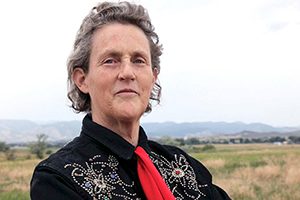
Photo credit: media.salon.com
Temple Grandin is the only person on this list with an official autism diagnosis. She’s also one of the most accomplished and influential figures in both animal science and autism advocacy.
Grandin is a Professor of Animal Science at Colorado State University, where she’s taught since 1990. She has spent her career designing livestock handling equipment that’s both more efficient and more humane. Her insight, that animals experience the world through sensory perception the way she does, heightened, intense, and detail-rich, shaped how she approached animal behavior. By her own account, the center-track restrainer system she designed handles close to half the cattle in the United States and Canada.
Grandin has written extensively about her early experiences. By her own account she showed signs as an infant. She didn’t speak until she was nearly four, and her mother often struggled to understand why she screamed. Colorado State’s own faculty biography notes that at age two she had no speech, and that years of speech therapy and intensive teaching brought it. Grandin described it later as knowing what she wanted to say but being unable to get the words out. Her senses were always running at what she called “full, overwhelming volume.” Touch was difficult. Sound was difficult. The world was often too much.
But she could also concentrate for long stretches, filtering out noise that derailed other people. Combined with a gift for detail and pattern, that served her well in a field built on close observation. She became an outspoken public voice for autistic people, publishing her autobiography Emergence: Labeled Autistic in 1986.
Grandin credits early intervention, her mother’s persistence, and mentors like her high school science teacher for much of what followed. For more stories like this, see our collection of autism success stories.
What This Means for Autistic Children Today
The stories above are inspiring, but they’re incomplete without this piece: none of these people had access to anything resembling modern autism support. Newton went through a breakdown nobody could explain. Tesla’s phobias were part of his life to the end. Darwin built a working life around not having to be in a room with people.
Today, autistic children have access to something those scientists didn’t. Evidence-based intervention that can help them build the skills they need while working with how they already think.
Applied behavior analysis is among the most extensively researched approaches to autism intervention. At its best, ABA therapy isn’t about making autistic individuals conform to neurotypical expectations. It’s about helping each person develop communication, independence, and adaptive skills in ways that fit how they actually think and learn.
If you’re thinking about a career in behavior analysis rather than researching support for a child, the master’s programs that lead to BCBA certification are the place to start.
Frequently Asked Questions
Were Einstein, Newton, and Tesla actually diagnosed with autism?
No. All three lived well before autism was a defined clinical diagnosis, and the DSM itself wasn’t developed until decades after their deaths. What researchers can do is look at historical accounts of their behavior and identify patterns that align with modern diagnostic criteria. These retrospective analyses are widely discussed but should be understood as informed speculation rather than confirmed diagnoses.
Did Charles Darwin have autism?
Nobody can answer that with certainty, and anyone who tells you otherwise is overreaching. What exists is an argument, made most prominently by Trinity College Dublin psychiatrist Michael Fitzgerald, that Darwin’s behavior fits an autism profile. The evidence cited is lifelong social difficulty, rigid daily routines, obsessive systematizing from adolescence onward, and a capacity for sustained focus that let him spend eight years on barnacles. The counterargument is that Darwin’s chronic ill health has several competing medical explanations, any of which could account for how much he withdrew. Darwin never received a diagnosis because the diagnostic category didn’t exist until the 1940s.
What is the connection between autism and STEM ability?
Research from Cambridge’s Autism Research Centre has found that people in STEM fields score higher on a self-report measure of autistic traits than people in non-technical work. The usual explanation points to cognitive tendencies associated with autism, including systemizing, pattern recognition, and a preference for rules over ambiguity. That’s a plausible reading rather than a demonstrated mechanism. The occupational study measured traits and job categories, not why the two go together.
How does ABA therapy support autistic strengths?
Modern ABA therapy is individualized, meaning a good program isn’t trying to use a one-size-fits-all approach. Behavior analysts conduct detailed assessments to understand how each person communicates, what motivates them, and where they need support. For a child with strong focus and systematic thinking, that might mean building on those natural tendencies while working on communication and social skills in parallel.
Are there famous autistic inventors beyond scientists?
Yes, though the categories need care. Grandin is an autistic scientist and an inventor in the plain sense, and she has a diagnosis. Everyone else in this conversation is either a living person who has disclosed publicly, like Elon Musk with Asperger’s syndrome, a term the DSM retired in 2013 when it was folded into autism spectrum disorder, or a historical figure assigned autism after the fact. Alan Turing falls in the second group, and Fitzgerald co-authored a paper asking the question about him directly. Names like Antoni Gaudi, Andy Warhol, and Hans Christian Andersen turn up in the same retrospective literature, on the same speculative footing.
What careers are autistic individuals especially well-suited for?
Career fit is individual, and the research here is about interests and occupational categories rather than aptitude. That said, autistic people are well represented in fields that reward focused expertise, pattern recognition, and systematic thinking, including technology, engineering, mathematics, and research science. Music and visual arts come up often too. ABA professionals can help autistic individuals identify and develop their specific strengths as part of a long-term education and career plan.
Key Takeaways
- Retrospective analysis, not diagnosis. None of the historical figures on this list (except Temple Grandin) received a clinical diagnosis of autism. Historians of science and some autistic self-advocates object to the practice of diagnosing the dead, and their objections are worth hearing.
- The STEM association is real but modest. Across 450,394 people, those in STEM careers scored about three points higher on a self-report measure of autistic traits, a small effect. It’s a correlation between traits and job category, not a measure of scientific ability.
- Darwin left the most detailed record. He wrote nearly everything down, which is why his is the case researchers return to most often, and the only one with a named psychiatrist behind it.
- Temple Grandin stands apart. As the only officially diagnosed person on the list, Grandin is also one of the most prominent autism advocates in modern history, and a living example of what’s possible with the right support.
- These scientists worked without modern support. Newton’s 1693 breakdown was never explained. Tesla’s phobias stayed with him. Darwin organized four decades around avoiding social contact.
- Modern support changes the picture. Evidence-based intervention can help autistic children develop communication, independence, and adaptive skills in ways that fit how they actually think and learn.