Some of the most decorated athletes in the world are on the autism spectrum. From Paralympic gold medalists and MLB stars to championship surfers and long-distance runners, these athletes have competed at the highest levels of their sports. Their stories challenge every assumption about what autistic people can and can’t do.


You’ve probably heard the warnings. The worried coaches. The well-meaning relatives who wondered whether a child on the autism spectrum could really handle competitive sports. The noise, the unpredictability, the social demands of a team environment.
But the evidence tells a different story. A growing number of elite athletes are autistic, and their success isn’t despite how their brains work. For many of them, the intense focus, the obsessive dedication to craft, and the comfort found in physical repetition are exactly what made them great. Research consistently shows that exercise supports autistic individuals, reducing anxiety and building social connections.
Here are some of the most accomplished famous athletes with autism.
Clay Marzo
Sport: Surfing
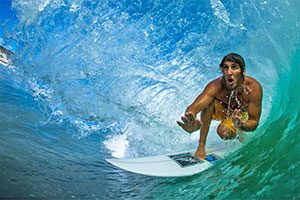
Clay Marzo grew up in Maui chasing waves. He was misdiagnosed repeatedly over the years, labeled with ADD, dyslexia, and learning disabilities before receiving an Asperger’s diagnosis at 18. By then, he’d already built a reputation in competitive surfing.
What followed was a career-defining film, Add Water, that introduced him to a much wider audience. ESPN coverage and a Rolling Stone feature cemented his profile as one of the most talented freesurfers in the world.
Ask Clay why he surfs, and the fame barely enters his answer. He’s described the ocean as the one place where everything clicks. Off the board, he struggles with eye contact, conversation, and navigating unfamiliar social situations. On it, he’s considered among the best who have ever done it.
His mother, Jill, put it this way: “Out of the water, he is not comfortable, even today. In the water, it’s like he can breathe.”
The hyperfocus that can make daily life challenging became the engine behind a world-class athletic career.
Tommy Dis Brisay
Sport: Running
At five years old, doctors told Tommy Dis Brisay’s parents he would likely never learn to speak. As a teenager, he struggled with weight, anxiety, and medication. None of that was the ending to his story.
His father, Peter, an avid runner, brought Tommy along for a jog. That first run turned into a full obsession. In the first year alone, Tommy lost 35 pounds and started entering races. He didn’t just participate. He started winning.
A half-marathon time of 1:14:55 is one of a long list of accomplishments. He’s also taken first in kayaking and cross-country skiing events. Running became the outlet that quieted his anxiety and, over time, drew him into a community.
The organizers of Ottawa Race Weekend made accommodations that let his father ride alongside him by bike during the race. Other runners embraced his habit of singing Disney songs mid-race. What might read as quirks to an outsider were simply Tommy being Tommy, and the running community accepted that.
Peter credits running with making Tommy less anxious, more social, and less reliant on medication. Says Tommy: “I run every day, every week, every month, every year.”
Jim Eisenreich
Sport: Baseball (MLB)
Jim Eisenreich broke into Major League Baseball in 1982 with the Minnesota Twins. But uncontrollable tics from Tourette’s Syndrome, combined with what would later be identified as Asperger’s, led to a difficult stretch that ended with him stepping away from the game in 1984.
He came back in 1986. By 1989, he’d won Kansas City Royals Player of the Year. His career spanned 15 seasons at the major league level.
Eisenreich’s return is its own kind of story. The combination of the right medication, a clearer understanding of his challenges, and his own determination brought him back to the field and kept him there for more than a decade.
Jessica-Jane Applegate
Sport: Swimming (Paralympic)
British swimmer Jessica-Jane Applegate is a multiple-time Paralympic medalist, including gold at the 2012 London Paralympics in the S14 200-meter freestyle and gold as part of the mixed S14 freestyle relay at the Tokyo 2020 Paralympics. She set a Paralympic record in the S14 200-meter freestyle at the London 2012 Paralympic Games and holds multiple British records. She’s also been open about her Asperger’s diagnosis since early in her career.
At the 2012 London Paralympics, she became the first British swimmer to win Paralympic gold in the S14 classification after the category returned to the Games. In 2013, she was appointed a Member of the Order of the British Empire (MBE) for her contributions to the sport.
She’s described what competition takes from her: “In training and competition, there are very few people who really understand how hard it is for me. I really struggle to cope with people socially. I don’t like any changes, and trying to concentrate on more than one thing is so difficult.”
Her coach adapted. They built timetables, created backup plans, and established the kind of predictable structure that lets her compete at full capacity.
David Campion
Sport: Snowboarding
Australian snowboarder David Campion represented his country at the Special Olympics World Winter Games in Austria, competing on one of the sport’s biggest stages after connecting with Disabled Winter Sport Australia.
He picked up snowboarding later than most competitive athletes, and he’ll tell you it took time to click. But once it did, there was no stopping him.
“I’d start getting frustrated with it. Then it came to me, kind of switched on, like riding a pushbike.”
His mother pushed him toward Disabled Winter Sport Australia and became his most consistent advocate. His story is straightforward: someone found something he was good at, and someone else in his life refused to let him stop trying.
A Note on Fernando Mendoza
Sport: Baseball (MLB)
Searches for “Fernando Mendoza autistic” have picked up considerable traffic recently, suggesting real public interest in whether the MLB pitcher is on the autism spectrum. We want to be upfront: we haven’t been able to confirm from a reliable source that Mendoza has publicly disclosed an autism diagnosis. We’ll update this section if that changes. If you have a verified source, we’d welcome the correction.
Frequently Asked Questions
Can autistic people compete in professional sports?
Yes, and many already have. Athletes, including MLB players, Paralympic gold medalists, and world-ranked surfers, have competed at the highest levels of their sports while being openly autistic. Autism affects people differently, and for some athletes, traits associated with autism, including intense focus and deep dedication to a single skill, have directly supported athletic excellence. The intersection of ABA and athletic training is a growing area of research for exactly this reason.
What sports are autistic athletes most commonly associated with?
No one sport suits autistic athletes better than others. The athletes featured here include surfers, runners, baseball players, swimmers, and snowboarders. Individual sports often offer more predictable sensory environments, but plenty of autistic athletes have succeeded in team settings as well. It comes down to the individual, their specific strengths, and the support structures around them.
How can parents support athletic development in autistic children?
Start with what your child is naturally drawn to. Forced participation rarely leads anywhere. Once there’s genuine interest, look for coaches and programs willing to make sensory and routine accommodations. Predictability, clear expectations, and a patient support structure matter more than the specific sport. Many of the athletes on this list got their start because one parent refused to accept a ceiling on what their child could do.
Are there autism-specific sports programs?
Yes. Organizations such as Special Olympics, Disabled Sports USA, and regional adaptive sports programs offer structured athletic environments designed for neurodiverse athletes. Many mainstream recreational leagues have also become more accommodating as awareness has grown. If these stories have sparked an interest in working with autistic individuals professionally, you can explore top ABA master’s programs to learn what a career in applied behavior analysis looks like.
Key Takeaways
- Elite autistic athletes exist across sports. Several professional and competitive athletes are openly autistic, competing in everything from MLB to Paralympic swimming to extreme sports.
- Autism traits can fuel athletic excellence. Hyperfocus and deep immersion in a single interest have helped drive some of these athletes to the top of their fields.
- Support structures make a real difference. Coaches and organizations that build in predictability and accommodate sensory needs have enabled some of these athletes’ best performances.
- Parents play a defining role. In nearly every story here, a parent’s refusal to accept a low ceiling made the difference between participation and championship.
- The conversation is growing. Public interest in athletes and autism reflects a broader cultural shift toward visibility and openness in professional sport.
Want to learn more about how ABA supports autistic individuals across all areas of life? Find a program that fits your goals.