AI in ABA Therapy: How Artificial Intelligence Is Changing the Field
AI is changing how ABA practitioners collect data, analyze behavior, and personalize treatment plans. From wearable sensors to machine learning models that can flag autism risk earlier than ever, artificial intelligence is opening new possibilities for practitioners and clients alike. Here’s what the integration of AI and ABA therapy actually looks like in practice.


Here’s something worth thinking about: the biggest bottleneck in ABA therapy has never been the science. The methods are well documented in the research literature, and, for many populations, the outcomes are strong. However, the field continues to have real conversations about intensity, approach, and client experience. The challenge has always been the time it takes to collect, analyze, and act on behavioral data.
That’s exactly where artificial intelligence is starting to make a difference. AI tools don’t replace the clinical judgment of a trained behavior analyst. Still, they can handle the time-intensive work of data processing, freeing practitioners to focus on what they do best: building meaningful relationships and designing effective interventions.
AI in Data Collection for ABA
In ABA, data collection typically involves monitoring behavior and recording event frequency, duration, and intervals. It’s a time-intensive process, and where there’s time pressure, there’s real opportunity for human error. Inaccurate data leads to weaker analysis, which leads to less effective treatment.
AI tools address these problems by streamlining the entire data collection process.
Automated Observations
ABA therapists often rely on video recordings to observe and document client behavior. The problem is that reviewing footage takes hours, and the behavioral episodes you’re looking for may only appear briefly.
AI tools can automatically watch video, identify targeted behaviors, and timestamp them without a practitioner having to scrub through recordings manually. It’s a capability that’s moved from research prototypes into early commercial implementation, and the time savings are significant.
IoT and Wearables
Smart wearable devices can continuously capture biometric data, including heart rate, brainwave activity, muscle signals, physical movement, and ambient sound. Using Internet of Things (IoT) technology, these devices transmit data directly to software platforms for visualization and analysis.

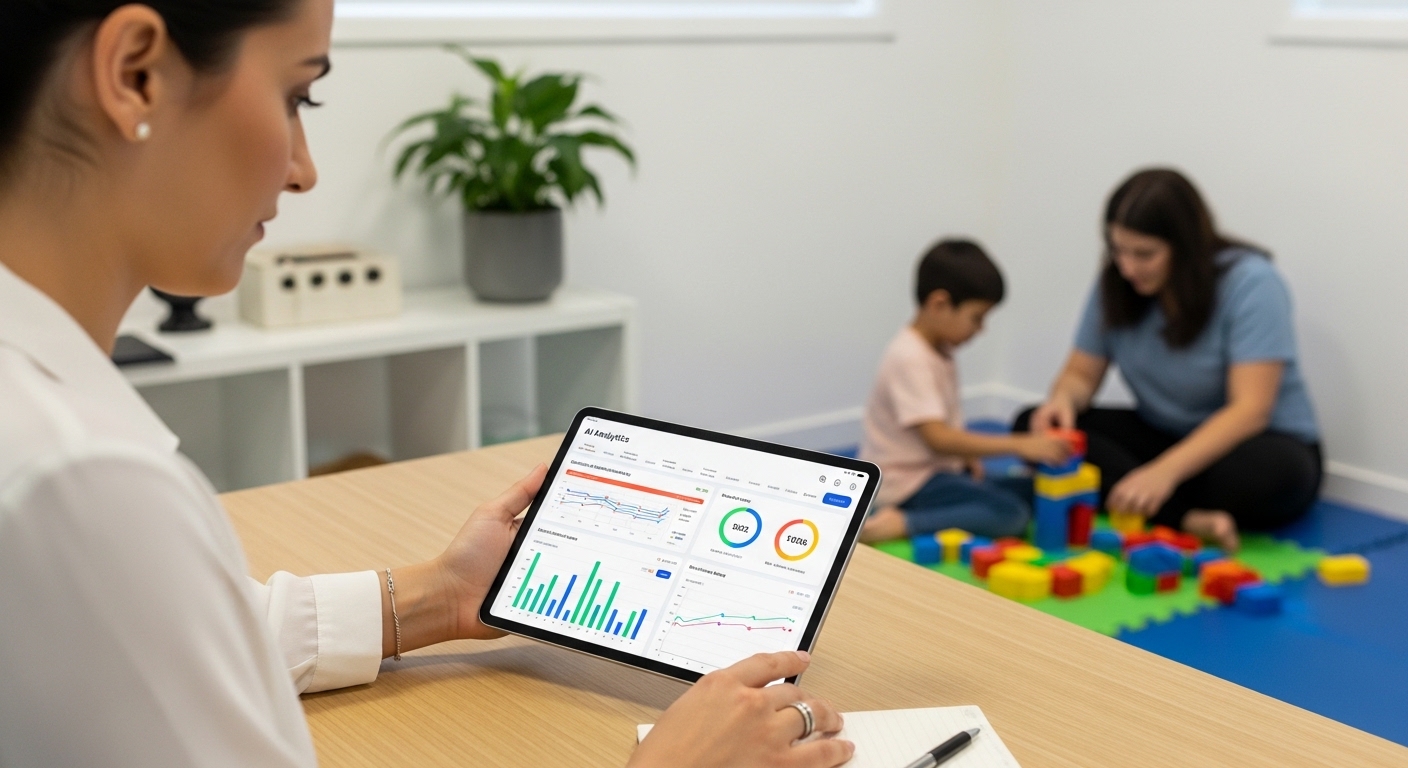
AI-powered tools are being integrated directly into ABA therapy sessions to support real-time data collection.
For clients who have difficulty communicating their internal states, wearables offer a way to gather objective physiological data that would otherwise be impossible to capture consistently.
Voice and Sound Recognition
AI tools can also analyze audio to detect vocal patterns, stress levels, and emotional states. For ABA practitioners working with clients who have limited verbal communication, this kind of data can add an entirely new layer of behavioral information to treatment planning.
The DE-ENIGMA project is a research initiative that uses AI-powered voice and sound recognition specifically to better understand the needs and behaviors of autistic children.
AI in Data Analysis for ABA
Collecting data is only half the equation. Analyzing it is where ABA practitioners have historically spent considerable time. Implementing ABC (Antecedent-Behavior-Consequence) analysis or plotting behavioral trends across sessions requires painstaking manual work, which carries a real risk of human bias.
AI addresses this by processing large datasets quickly and consistently, though it’s worth noting that AI models trained on historical data can inherit biases depending on what that data reflects.
Automated Pattern Recognition
An AI tool can scan hours of recorded behavioral data and identify patterns in seconds. Think about what that means in practice: a behavior analyst who might spend an entire afternoon reviewing session videos can instead receive a structured analysis in under a minute, then spend that afternoon on intervention planning.
Real-Time Feedback
One of the most significant advantages AI brings to ABA is speed. Human analysis takes time, often days. AI-generated feedback can arrive almost immediately, enabling practitioners and caregivers to adjust interventions in real time rather than waiting for the next data review session.
Integrating Multi-Modal Data
ABA data rarely comes from a single source. Wearables, session videos, audio recordings, and practitioner notes all capture different pieces of the picture. Bringing them together into a unified analysis has traditionally been one of the most labor-intensive parts of the work.
AI platforms can consolidate data from multiple sources and synthesize it into coherent, actionable insights, which is something that previously required significant manual effort.

AI tools are helping ABA practitioners gather richer behavioral data without adding to their documentation burden.
Predictive Modeling in ABA Using Machine Learning
Predictive modeling uses historical data and statistical techniques to forecast likely outcomes. In ABA, that capability enables real applications, from early intervention to smarter resource allocation.
Machine learning models can support early identification by flagging children at elevated risk for behavioral challenges before those challenges become severe. Research published in JAMA Network Open analyzed 45,080 cases and confirmed that EHR-based predictive models could flag elevated autism risk as early as 30 days of age. That’s probabilistic risk modeling, not a clinical diagnosis at 30 days, but the implication is significant: earlier identification means earlier support, and earlier support consistently produces better developmental outcomes.
Predictive models are also being used to help behavior analysts tailor intervention plans. With sufficient demographic, environmental, and treatment history data, a model can help identify which approaches are most likely to work for a specific client, reducing reliance on trial-and-error alone. You can read more about how ABA is expanding into new fields and applications as these tools develop.
On the resource-allocation side, ABA interventions can be time- and cost-intensive. Predictive tools can help practitioners and organizations direct their resources to clients most likely to benefit from specific interventions, which is especially important when caseloads are high and time is limited.
A practical example from adjacent research: in 2017, Northwestern University developed an app called Mobilyze that used smartphone sensor data to predict depressive episodes with 90% accuracy in a pilot cohort, a promising early result, though the sample size was limited. While not an ABA tool directly, it demonstrates what’s possible when behavioral data meets machine learning.
Building a predictive model for ABA follows a consistent process:
- Data Collection — Gather relevant data from multiple sources to train the model.
- Feature Selection — Identify the key variables that influence the target behavior.
- Model Training — Train the program using historical data.
- Model Validation — Test the model’s predictions against real-world outcomes.
- Deployment — Implement the model in a live environment and continuously update it as new data arrives.
It’s an iterative process, not a one-time setup.
Challenges and Considerations
It would be easy to frame AI as a straightforward upgrade to ABA practice. The reality is more complicated.
Data Privacy
The more data AI tools collect, especially through wearables and continuous monitoring, the more critical data privacy becomes. Behavioral and biometric data are sensitive, and the systems that handle them need to meet rigorous security and consent standards. This is an active area of concern for both practitioners and technology developers, and it doesn’t yet have settled answers.
The Human Element
There’s something important that AI tools simply can’t replicate: the therapeutic relationship. The rapport a skilled behavior analyst builds with a client and their family is a core part of what makes ABA effective. AI can process data, but it can’t sit with a family through a hard session or notice the subtle shift in a client’s engagement that an experienced practitioner catches immediately.
It’s also worth noting that AI models trained on historical data can introduce bias. Data reflects the decisions that produced it, and if those decisions had gaps, the model will too.
Learning Curve for Practitioners
Many ABA practitioners were trained in manual data collection methods, and that’s still the foundation of the field. Adopting AI tools requires time, training, and a willingness to adapt established workflows. The tools are only as useful as the practitioners who know how to use them, and that’s a genuine consideration for anyone evaluating whether and how to bring AI into their practice.
What This Means for Your ABA Career
If you’re studying for your BCBA or thinking about where the field is heading, AI literacy is becoming a practical skill set. Practitioners who understand how to work with AI-generated data, interpret model outputs, and apply them within a behavioral framework are better positioned as these tools become more common in clinical and organizational settings.
That doesn’t mean you need to become a data scientist. It means understanding what these tools can and can’t do, knowing when AI-generated insights should inform your clinical judgment and when they shouldn’t, and being thoughtful about the ethical considerations that come with collecting and analyzing sensitive behavioral data.
The field is evolving quickly, and practitioners who stay informed tend to adapt well. Our coverage of new research areas and findings in ABA is a good place to keep up with where things are heading. If you’re earlier in your path and still exploring graduate programs, you can explore top ABA master’s programs to find programs that prepare you for a field that’s changing fast.
Frequently Asked Questions
Can AI replace ABA therapists?
No. AI tools can process and analyze behavioral data faster than any human. Still, they can’t build therapeutic relationships, apply clinical judgment in complex situations, or adapt to the nuances of a real session. AI is a tool that supports ABA practitioners, not a replacement for them.
What kinds of AI tools are ABA practitioners currently using?
ABA-specific AI tools include automated data-collection platforms, video-analysis software, wearable biometric monitoring systems, and predictive analytics tools for treatment planning. The field is still developing, and the range of available tools is expanding quickly.
Does the BACB regulate the use of AI in ABA?
The BACB hasn’t issued specific AI-use guidelines as of early 2026, but practitioners are still bound by the Ethics Code, which requires data privacy, informed consent, and evidence-based practice. Any AI tool used in an ABA context should be evaluated against those standards.
Are there privacy concerns with using AI in ABA therapy?
Yes. Continuous data collection through wearables and video monitoring raises real questions about consent, data storage, and security. Practitioners and organizations need clear protocols for how behavioral and biometric data is collected, stored, and used.
How can I learn more about technology trends in ABA?
A good starting point is staying connected to published research and professional organizations like ABAI. You can also explore our overview of ABA and technological advancements for a broader look at where the field is heading.
Key Takeaways
- AI supports ABA practitioners; it doesn’t replace them. Tools for data collection, behavioral analysis, and predictive modeling reduce the time burden on clinicians without replacing their clinical judgment or therapeutic relationships.
- Wearables and video analysis are expanding what’s measurable. Continuous biometric monitoring and automated video review give practitioners access to behavioral data that was previously difficult or impossible to capture consistently.
- Predictive modeling shows real promise for early identification. EHR-based models have demonstrated the ability to flag elevated autism risk as early as 30 days of age, pointing toward earlier intervention and better outcomes.
- Data privacy and algorithmic bias are genuine concerns. The more behavioral and biometric data AI systems collect, the more critical, rigorous privacy protocols and thoughtful model evaluation become.
- AI literacy is becoming a useful skill for ABA professionals. Practitioners who understand how to interpret and apply AI-generated data will be better positioned as these tools become more common in clinical and organizational settings.
Ready to take the next step in your ABA career? Whether you’re just starting your degree search or working toward BCBA certification, finding the right program sets the foundation for everything that follows.